
Stock Market · hashem almsri · August 17, 2026
AI Monetization Is Accelerating — and So Is the Compute Demand Behind It
Elite Academy Desk — here is a clear take on the latest market development for traders following the story.
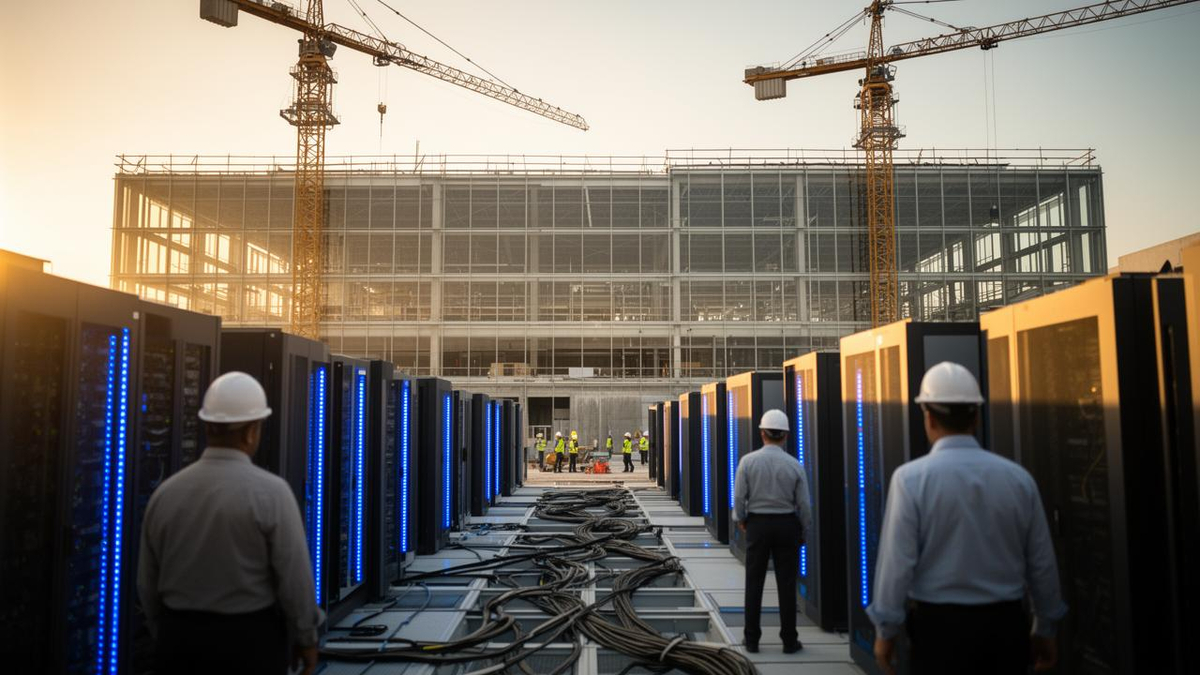
South Korea's three major telecom operators have entered a large-scale investment race, positioning artificial intelligence data centers (AIDC) as their next core revenue engine. SK Telecom has set an ambitious target of 15GW of capacity by 2035, while KT has disclosed plans to invest 5 trillion won (approximately $3.5 billion) over five years to secure 1GW. LG Uplus is accelerating construction of the largest AIDC in the Seoul metropolitan area with an additional 1.35 trillion won (approximately $955.3 million) investment in Paju. based on industry sources on the 16th, all three telecom companies are leaning toward a phased expansion approach—verifying customer demand, power availability, and site conditions before scaling supply capacity—rather than deploying massive capital all at once. As investment size grows, so does capital burden. The strategy is to secure global Big Tech customers first, then leverage project-specific external funding or asset-light business models to improve investment efficiency. In terms of investment plans alone, SK Telecom's scale is the most overwhelming. The company said it would expand capacity from 5GW in 2028 to 15GW by 2035. As recently as July last year, the target was 300MW or more by 2030 with annual AIDC revenue of 1 trillion won (approximately $708.2 million), but the goal has been dramatically raised within a year. The structure calls for phased openings of 5GW each starting in 2029, reaching 15GW by 2035. The company plans to build an AIDC cluster of 2GW or more in South Korea's Yeongnam region (Gyeongsang provinces), including Ulsan, and expand to hubs in the southwestern region. To support this, SK Hyper, a dedicated business development subsidiary, was launched on the 23rd of last month. SK Telecom plans to inject up to 750 billion won (approximately $531.2 million) into SK Hyper, its wholly owned subsidiary, by 2030. SK Hyper will be responsible for securing AIDC sites, building shared infrastructure such as substations, attracting customers, and business development. still, not all 15GW will be built with SK Telecom's own capital. The company is pursuing a model of securing customers first for each large-scale project, then utilizing strategic market participants, financial market participants, or project financing (PF) to reduce direct capital burden. The key question going forward is how quickly the 15GW long-term target converts into actual projects. Long-term contracts with global Big Tech players, power procurement, site acquisition, and permitting must all proceed sequentially for the massive target capacity to translate into real investment. KT has presented a smaller but more clearly defined investment plan than SK Telecom. Beyond securing 1GW of AIDC capacity over the next five years starting this year, KT will invest 1 trillion won (approximately $708.2 million) in submarine cables, bringing total AI transformation (AX) infrastructure investment to 6 trillion won (approximately $4.2 billion). Rather than securing 1GW as a single mega data center, KT plans to combine existing infrastructure with new data centers to build approximately 25 AIDC facilities. The vision is to network AI compute infrastructure by linking large-scale central AIDCs, regional hubs, and AI edge capabilities leveraging approximately 3,500 telecom offices nationwide. KT is moving beyond simply expanding AIDC as a facilities business to monetizing AI services themselves. The flagship initiative is Token Factory. The company plans to build a platform that optimizes model and compute resources during AI token generation and processing, and connects usage measurement to billing—directly converting AI compute demand generated from AIDC infrastructure into revenue. KT is targeting commercial launch of Token Factory in October and has set a goal of doubling AX revenue by 2028 from current levels. LG Uplus is expanding AIDC investment centered on specific large-scale projects, with Paju as the key hub. The company is building a 200MW-class hyperscale AIDC in Paju, with the first computing building scheduled for completion in June next year. The first building can accommodate up to 50MW and has already secured customer contracts. LG Uplus aims to achieve cumulative AIDC orders of 5 trillion won (approximately $3.5 billion) by 2030. On the 29th of last month, the company disclosed a new inve